One of the biggest shocks for new self-employed people is the January tax bill. No one takes tax off your money as you earn it, so you need to put it aside yourself. This guide explains how much to set aside as a UK sole trader in the 2026/27 tax year, with worked examples, and how to make it a habit.
The short answer
A common rule of thumb is to set aside 20–30% of your profit. Use the lower end if your profit is under about £50,000, and the higher end above that. The examples below show where those numbers come from. Remember it’s a percentage of profit (income minus allowable expenses), not of everything you take in.
Get this guide as a free PDF
Keep it, print it, read it offline. We’ll email it to you with a personal 10% discount code for any spreadsheet.
The 2026/27 rates for sole traders
For England, Wales and Northern Ireland:
| Profit band | Income Tax | Class 4 National Insurance |
|---|---|---|
| Up to £12,570 (personal allowance) | 0% | 0% |
| £12,571 to £50,270 | 20% (basic rate) | 6% |
| £50,271 to £125,140 | 40% (higher rate) | 2% |
| Over £125,140 | 45% (additional rate) | 2% |
- Your personal allowance shrinks once your income goes over £100,000.
- Class 2 National Insurance is no longer compulsory. If your profits are under £7,105 you can choose to pay it voluntarily (£3.65 a week) to protect your State Pension.
- Scotland has different Income Tax rates and bands. National Insurance is the same.
- These figures assume self-employment is your only income. If you also have a job or other income, your rates may be different.
Worked example 1: £30,000 profit
| Income Tax: (£30,000 − £12,570) × 20% | £3,486.00 |
| Class 4 NI: (£30,000 − £12,570) × 6% | £1,045.80 |
| Total | £4,531.80 |
| As a percentage of profit | about 15% |
Worked example 2: £60,000 profit
| Income Tax: £37,700 × 20% | £7,540.00 |
| Income Tax: (£60,000 − £50,270) × 40% | £3,892.00 |
| Class 4 NI: (£50,270 − £12,570) × 6% | £2,262.00 |
| Class 4 NI: (£60,000 − £50,270) × 2% | £194.60 |
| Total | £13,888.60 |
| As a percentage of profit | about 23% |
So why set aside 20–30% when the actual bill is 15–23%? Because of payments on account, which catch out a lot of people in their first years.
Payments on account: the January surprise
If your last tax bill was more than £1,000, HMRC usually asks you to pay towards next year’s bill in advance, in two instalments:
- 31 January: the balancing payment for the last tax year, plus the first payment on account for the current year (half of last year’s bill).
- 31 July: the second payment on account (the other half).
In your first big year, that means paying around 1.5 years’ worth of tax in one January. Putting aside a little more than you need covers it, and anything left over is a bonus.
Making Tax Digital is here
From April 2026, sole traders and landlords with qualifying income (turnover, before expenses) over £50,000 must use Making Tax Digital for Income Tax. That means keeping digital records and sending quarterly updates to HMRC using compatible software. The threshold drops to £30,000 from April 2027. Check GOV.UK to see if it applies to you.
How to make setting tax aside a habit
- Open a separate savings account just for tax, ideally one that pays interest.
- Move your percentage every time you’re paid, or at least once a week. Don’t wait until the end of the month.
- Track your profit as you go, not just your income, so you know whether your percentage is right.
- Log every allowable expense and business mile. Each one reduces your profit, and therefore your tax. Business mileage for cars and vans is 55p a mile for your first 10,000 business miles in the tax year (see our mileage guide).
- Check part-way through the year. If you’re earning more than expected, increase your percentage.
A simple way to see your tax figure all year
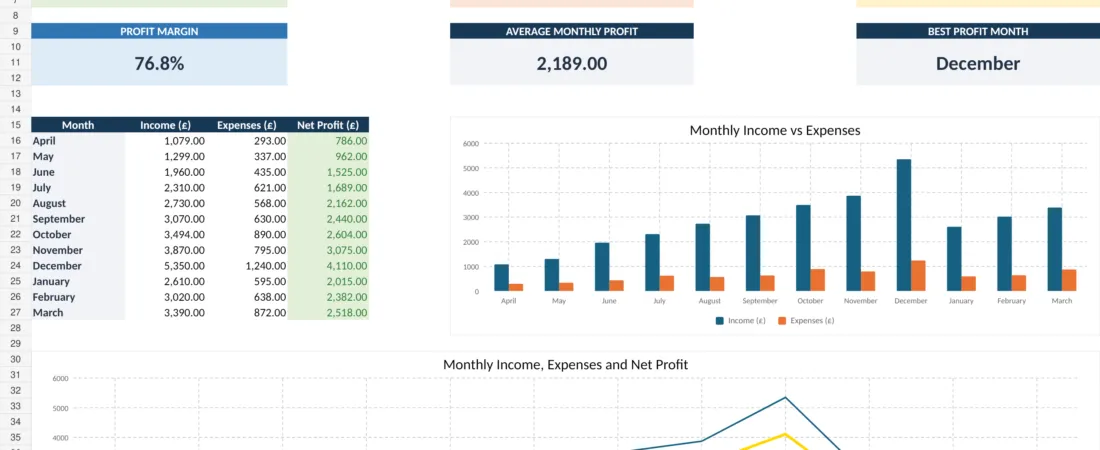
Our business Command Centres include a tax reserve setting. You choose your percentage, and the Dashboard shows how much of your profit to put aside, updated as you add income and expenses:
- Trade Business Command Centre (£29.99): jobs, invoices, expenses, mileage and a tax year summary for tradespeople.
- Command Centres for hairdressers, beauticians, dog groomers and photographers (£29.99 each).
For something simpler, the Income & Expense Tracker (£11.99) keeps tidy income and expense records ready for your tax return, and the Mileage & Expenses Log (£9.99) records every business trip and expense.
They’re spreadsheets for keeping your records organised. They aren’t MTD software, so if MTD applies to you, you’ll need compatible software to send your updates to HMRC.
Related guide: Allowable Expenses for the Self-Employed: UK Guide and Examples.
Self-employed tax FAQs
What percentage should I save for tax as a sole trader?
20–30% of your profit is a sensible range for most people. It covers Income Tax, Class 4 National Insurance and the payments on account that often arrive in your second year.
When do I pay my tax?
The online Self Assessment deadline and the balancing payment are both due on 31 January after the tax year ends. If payments on account apply, there’s a second payment on 31 July.
Do I pay tax on all my income?
No, only on your profit, which is your income minus allowable business expenses. That’s why keeping good records of expenses and mileage matters so much.
This guide is general information based on GOV.UK rates for the 2026/27 tax year (England, Wales and Northern Ireland), not tax advice. Your situation may be different, for example if you have other income or live in Scotland. Check GOV.UK or speak to an accountant.
Get this guide as a free PDF
Keep it, print it, read it offline. We’ll email it to you with a personal 10% discount code for any spreadsheet.