
As a self-employed photographer in the UK you can claim the costs of running your business against your income: cameras, lenses and lighting, editing software, insurance, website and gallery fees, marketing, business mileage, training, and the business share of your phone and home costs. Personal use has to be taken out, and some costs, like everyday clothes and entertaining clients, aren’t allowed at all.
This guide lists the main photography business expenses, checked against HMRC’s guidance on expenses if you’re self-employed, and shows how to handle the tricky bits: expensive kit, mixed use, and travel.
Get this guide as a free PDF
Keep it, print it, read it offline. We’ll email it to you with a personal 10% discount code for any spreadsheet.
Photography business expenses you can claim
| Expense | Allowable? | Notes |
|---|---|---|
| Cameras, lenses, lighting, memory cards | Yes | As an expense under cash basis, or capital allowances under traditional accounting. |
| Computer and monitor for editing | Yes (business share) | Only the business proportion if you also use it personally. |
| Editing and gallery software subscriptions | Yes | HMRC allows software you pay for regularly to renew. |
| Website, hosting, domain | Yes | HMRC lists website costs as allowable. |
| Advertising, directory listings, printed marketing | Yes | Including promotional items with your logo, within HMRC limits. |
| Prints, albums, frames sold to clients | Yes | Goods you resell are allowable. |
| Insurance (public liability, professional indemnity, equipment) | Yes | Business insurance policies are allowable. |
| Business mileage, parking, train fares | Yes | Business journeys only, not commuting to a regular studio. |
| Hotels and meals on overnight business trips | Yes | For example, a destination wedding. |
| Training and workshops | Usually | If it updates skills you use in your business. |
| Studio rent | Yes | Rent for business premises. |
| Phone and internet | Business share | Claim the proportion used for business. |
| Trade body membership and photography magazines | Yes | If related to your business. |
| Bank and card fees | Yes | Including payment processor charges. |
| Everyday clothes, even “shoot outfits” | No | HMRC says everyday clothing isn’t allowable. |
| Entertaining clients | No | Including food and drink for clients. |
| Parking fines | No | Fines and penalties aren’t allowable. |
Cameras, lenses and other expensive kit
Since April 2024 the cash basis is the standard method for most sole traders. Under the cash basis, equipment like cameras, lenses, lighting and computers is claimed as an allowable expense in the tax year you pay for it. So a £2,000 camera body bought in June 2026 reduces your 2026/27 profit by £2,000 (or the business share of it).
If you use traditional (accruals) accounting, you claim capital allowances instead. The annual investment allowance is £1 million, so for most photographers the full cost of kit can still be deducted in the year you buy it. Cars are different: they don’t qualify for the annual investment allowance.
When you sell old kit, the money you receive may need to be included as business income. Keep a simple list of equipment, what you paid and when, and what you sold it for.
Mixed use: kit you also use for fun
Many photographers also shoot for pleasure. HMRC only lets you claim the business proportion of anything used privately. If you estimate a camera is used 80% for paid work, claim 80% of the cost. Pick a fair, reasonable method and keep a note of how you worked it out, for example by counting shoots or editing hours over a typical month.
Travel and mileage
Driving to shoots, venues, client meetings, suppliers and workshops is business travel. HMRC doesn’t allow travel between home and work, so if you rent a studio and go there every day, that’s normally commuting.
For your car, you can claim either a share of actual running costs or HMRC’s flat rate: 55p a mile for the first 10,000 business miles in the 2026/27 tax year and 25p after that. Parking and train fares are claimable on top. Our guide on how to claim business mileage in the UK explains the rules and the log you need.
Working from home
If you edit at home for 25 hours or more a month, you can use HMRC’s flat rate: £10 a month for 25–50 hours, £18 for 51–100 hours, and £26 for 101 hours or more. Or claim a fair share of actual costs like heating and electricity based on rooms and time used. Editing takes hours, so the higher band is often realistic for a busy photographer.
Starting out: costs before your first paid job
If you’re turning a hobby into a business, HMRC can allow some day-to-day costs you paid in the seven years before you started trading, as long as they would have been allowable once you’d started. Kit you already owned is treated differently, so ask an accountant how to bring existing equipment into the business.
Worked example
A portrait photographer takes £28,000 in the 2026/27 tax year. Her allowable costs:
| Expense | Amount |
|---|---|
| New camera body (£2,000, 80% business) | £1,600 |
| Software and galleries | £600 |
| Insurance | £250 |
| Website and marketing | £900 |
| Mileage (2,000 miles at 55p) | £1,100 |
| Prints and albums sold | £1,400 |
| Phone (business share) | £240 |
| Working from home (12 months at £18) | £216 |
| Total | £6,306 |
Her taxable profit is £28,000 − £6,306 = £21,694. In the basic-rate band, each £100 of allowable expenses saves about £26 (20% Income Tax plus 6% Class 4 National Insurance for 2026/27), so the camera alone saves her about £416. To plan for the bill, see how much tax to set aside when self-employed.
Bookkeeping habits that make this easy
- Use a separate bank account for the business.
- Photograph every receipt the day you get it.
- Log mileage after each shoot, not from memory in January.
- Keep records for at least 5 years after the 31 January deadline for that tax year.
- Don’t use the £1,000 trading allowance if your real costs are higher; you can’t claim both.
Knowing your real costs also tells you what to charge. Our guide to how to price photography in the UK turns these figures into a minimum session price.
See also: Allowable Expenses for the Self-Employed: UK Guide and Examples.
An easy way to keep on top of it
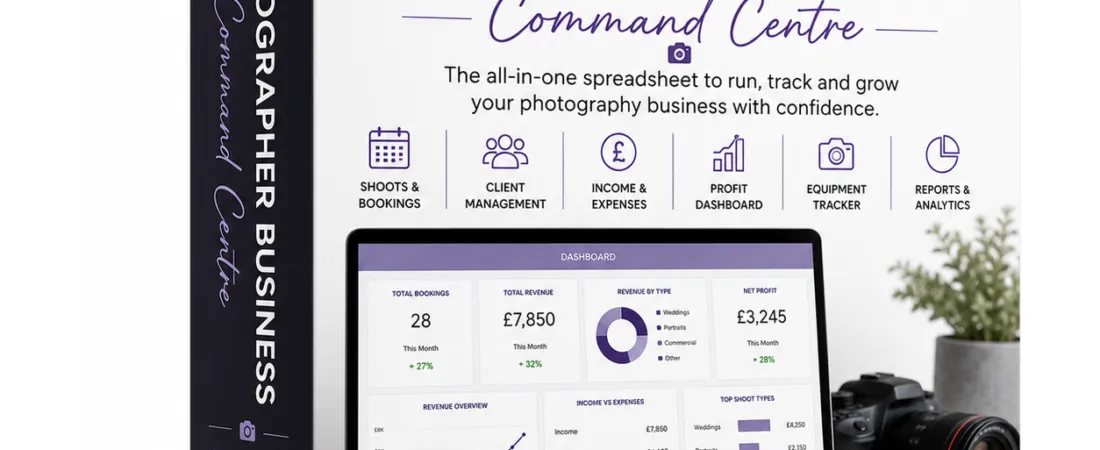
The Photographer Business Command Centre is a spreadsheet for Excel and Google Sheets that keeps your income, costs and mileage in one place, ready for your Self Assessment.
- Expenses logs spending with a category dropdown and gives you an automatic category breakdown.
- Mileage links business trips to bookings and works out claimable mileage at your rate (55p and 25p for 2026/27, editable in Settings).
- Bookings and Invoice Log keep a record of every job and every invoice you’ve sent.
- Dashboard shows revenue, expenses, net profit, mileage claimable and an estimated tax reserve.
See the Photographer Business Command Centre →
Photography expenses FAQs
Can I claim my camera as a business expense?
Yes. Under the cash basis it’s an allowable expense in the year you buy it; under traditional accounting you claim capital allowances. Only claim the business share if you also use it personally.
Can photographers claim clothes for shoots?
No, not everyday clothes, even if you only wear them to shoot. Protective clothing or a genuine uniform can be claimed. Props and costumes used in your photography can usually be claimed.
Can I claim Adobe and other software subscriptions?
Yes. HMRC allows software you pay for regularly to renew the licence, such as editing and gallery subscriptions.
Do I need receipts for everything?
Keep evidence for every cost you claim: receipts, invoices or bank statements. Digital copies are fine.
This guide is general information, not tax advice. Rules and rates are for the 2026/27 tax year in the UK. Check GOV.UK or an accountant, especially for equipment you owned before starting and for vehicle costs.
Get this guide as a free PDF
Keep it, print it, read it offline. We’ll email it to you with a personal 10% discount code for any spreadsheet.