
Price a job too low and you work for nothing. Price it too high and you lose the job. Most tradespeople guess, or copy what the last person charged. This guide shows a simple way to work out what you need to charge, then turn that into a quote you can stand behind.
Step 1: Work out your real day rate
Your day rate isn’t what you want to take home. It has to cover your pay and every cost of running the business, spread over the days you can actually bill.
Get this guide as a free PDF
Keep it, print it, read it offline. We’ll email it to you with a personal 10% discount code for any spreadsheet.
Add up your yearly running costs
- Van lease or loan, insurance, tax, fuel, servicing and tyres
- Public liability (and tools) insurance
- Tools and equipment, including replacements
- Phone, software, website and advertising (lead sites, flyers)
- Training, tickets and trade memberships
- Accountant, bank and card fees
Decide what you need to earn
Pick the yearly profit you need before tax. Remember that as a sole trader there’s no sick pay, holiday pay or pension unless you build it into your price.
Count your billable days honestly
There are about 260 weekdays in a year. Take off holidays, bank holidays and a few sick days, then take off the days spent quoting, buying materials, driving between jobs and doing paperwork. Many trades end up with somewhere around 180–210 billable days. Use your own numbers if you know them.
The formula
Day rate = (yearly running costs + yearly profit you need) ÷ billable days
Worked example
| Item | Amount |
|---|---|
| Running costs (van, insurance, tools, phone, ads, accountant) | £12,000 |
| Profit you need before tax | £36,000 |
| Total to recover | £48,000 |
| Billable days | 200 |
| Minimum day rate | £240 |
That’s your floor, the least you can charge without going backwards. Materials come on top.
Step 2: Price the materials properly
- List every material with current prices. Prices change, so don’t rely on last year’s quote.
- Add a waste allowance for offcuts, breakages and spares (often 5–15% depending on the trade and material).
- Add a handling markup for the time spent sourcing, collecting and carrying materials, and the money you’re out of pocket until you’re paid. Many trades add 10–20%; choose what’s normal in your area.
- Include skips, plant hire and parking. These are easy to forget and come straight off your profit.
Step 3: Build the quote
Quote = (days × day rate) + materials + markup + extras (skips, hire, waste) + a contingency for the unknown
For jobs where you can’t see everything (old houses, hidden pipes, rotten timber) add a contingency, or write clearly what isn’t included and how extras will be charged.
Example: a small bathroom refit
| Line | Amount |
|---|---|
| Labour: 5 days × £240 | £1,200 |
| Materials (tile adhesive, grout, fittings, pipework, sealant) | £650 |
| Waste and handling markup (15%) | £98 |
| Skip | £260 |
| Total quote | £2,208 |
These figures are only an illustration. Your costs, rates and local prices will be different.
Step 4: Quote or estimate?
- A quote is normally treated as a fixed price for the work described.
- An estimate is your best guess, and the final price can change.
Whichever you use, put it in writing. Say what’s included and what isn’t, how long the price is valid for, and your payment terms.
Step 5: Deposits and payment terms
- For bigger jobs, many trades ask for a deposit to cover materials before starting, and stage payments on longer jobs.
- Set clear payment terms (for example “payment due within 7 days”) and put them on every invoice.
- Keep track of who owes you what. Chasing unpaid invoices costs time you can’t bill for.
What about VAT?
You must register for VAT if your VAT-taxable turnover goes over £90,000 in any rolling 12 months. It’s not your tax year, so check it at the end of every month. If you’re VAT registered, make it clear whether your quotes include or exclude VAT. Check GOV.UK or your accountant for your own situation.
Common pricing mistakes
- Forgetting non-billable time. Quoting, travel and admin are real work, so build them into the day rate.
- Not charging for materials handling. Your time and van fuel to fetch them aren’t free.
- Racing to the bottom. Being the cheapest quote isn’t a business plan. Good customers value reliability and tidy work.
- Not reviewing your rate. Fuel, materials and insurance rise every year, so check your numbers at least once a year.
- Never checking what a job actually made. Compare your quote with your real hours and costs afterwards, so the next quote is better.
Related guide: What to Include on an Invoice: A UK Tradesperson’s Guide.
An easy way to keep on top of it
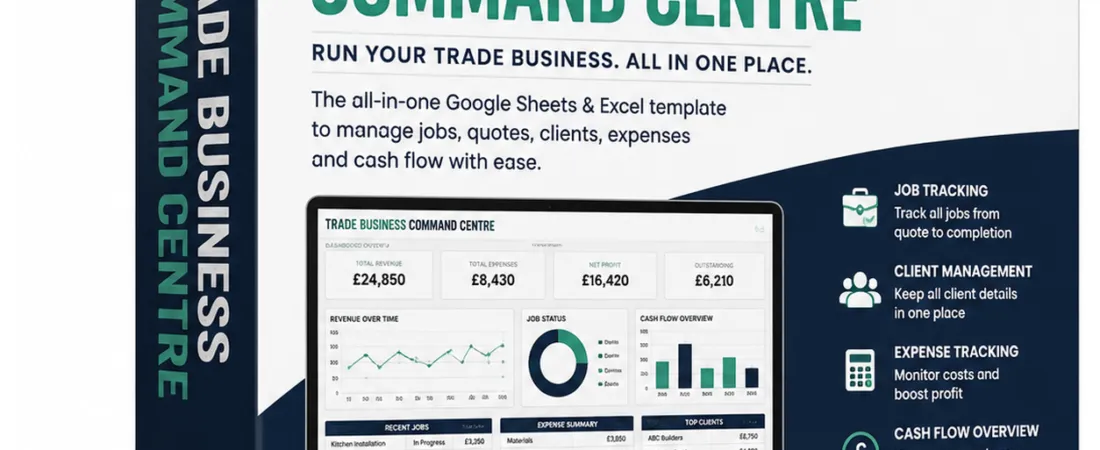
Our Trade Business Command Centre is an Excel and Google Sheets spreadsheet built for tradespeople. It helps you price and track every job and see what each one really made:
- Log every enquiry, quote and job, with balance due and Paid / Outstanding / Overdue status worked out for you.
- Record costs against each job, so you can see the profit on every job.
- Turn a job into a professional invoice in seconds, and keep a register of every invoice sent.
- Track expenses and mileage (55p a mile is set as the default and you can change it), with a Dashboard showing revenue, costs, profit and tax to set aside.
- £29.99 one-off, instant download, no subscription. Includes a filled-in example file.
See the Trade Business Command Centre →
Working in the US? There’s a US Edition with dollars, the IRS mileage rate and Schedule C categories.
Job pricing FAQs
Should I charge by the day or by the job?
Many trades use a day rate to work out the price, then give the customer a fixed price for the job. Customers like knowing the total, and you still know your numbers add up.
How much should I charge for travel?
Short local travel is usually built into your day rate. For jobs further away, many trades add a travel charge or set a minimum charge.
Should I put my prices up?
If you’re always fully booked, often win every quote, or your costs have gone up, it’s probably time. Review your day rate at least once a year.
This guide is general information, not financial or tax advice. Figures are examples only. Check your own costs, and speak to an accountant if you’re unsure.
Get this guide as a free PDF
Keep it, print it, read it offline. We’ll email it to you with a personal 10% discount code for any spreadsheet.