
To calculate GP on food, take the menu price, remove the VAT, subtract what the dish costs you to make, then divide the result by the price without VAT. A dish that sells for £18 and costs £4.20 to plate makes £10.80 gross profit, a GP of 72%, because £18 includes £3 of VAT that is HMRC’s money, not yours. Below is the formula, a full worked example, how to price a dish to hit a target GP, and how to check your kitchen’s real GP each week.
The GP formula and food cost percentage
Pubs and restaurants in the UK usually talk about GP (gross profit percentage). Other businesses, and most American articles, talk about food cost percentage. They are two sides of the same number and always add up to 100%.
Get this guide as a free PDF
Keep it, print it, read it offline. We’ll email it to you with a personal 10% discount code for any spreadsheet.
- Net selling price = menu price ÷ 1.2 (if you’re VAT-registered and the dish is standard-rated at 20%)
- Gross profit (£) = net selling price − plate cost
- GP % = gross profit ÷ net selling price × 100
- Food cost % = plate cost ÷ net selling price × 100
Food eaten on your premises and hot takeaway food are standard-rated for VAT, so most of what a pub or restaurant sells carries 20% VAT. If you’re not VAT-registered (the registration threshold is currently £90,000 of taxable turnover), you don’t charge VAT, so use the full menu price.
Step 1: Cost the plate properly
Your GP is only as good as your plate cost. Cost every component of the dish as served, by weight, at today’s supplier prices, and include the garnish, sauce and side.
The trap most kitchens fall into is yield. If you buy 5kg of beef chuck for £62.50 (£12.50/kg) and lose 0.75kg in trimming, you only have 4.25kg to sell. Your real cost is £62.50 ÷ 4.25 = £14.71 per usable kg, not £12.50. Use the usable cost in your recipe.
Write each recipe down once, as a costing sheet you update when supplier prices change. Whether you use paper, your own sheet or the costing tab in our Hospitality Command Centre, the important part is that every dish is costed the same way. Here’s a steak and ale pie with mash and greens:
| Component | Portion | Cost |
|---|---|---|
| Beef chuck (after trimming, £14.71/kg) | 200g | £2.94 |
| Puff pastry (£3.00/kg) | 80g | £0.24 |
| Ale, stock, onion, seasoning | per portion | £0.40 |
| Mash (potatoes, butter, milk) | 250g | £0.45 |
| Seasonal greens | 100g | £0.30 |
| Gravy | per portion | £0.15 |
| Plate cost | £4.48 |
Step 2: Work out the GP at your current price
The pie is on the menu at £16.95.
- Net selling price: £16.95 ÷ 1.2 = £14.13
- Gross profit: £14.13 − £4.48 = £9.65
- GP %: £9.65 ÷ £14.13 = 68.3%
- Food cost %: £4.48 ÷ £14.13 = 31.7%
Step 3: How to price a dish to hit a target GP
Turn the formula round. To find the menu price that gives you a target GP:
Menu price = plate cost ÷ (1 − target GP) × 1.2
If your target is 70% GP, the pie needs to sell for £4.48 ÷ 0.30 = £14.93 before VAT, which is £17.92 with VAT. Round it to £17.95 on the menu. Check it: £17.95 ÷ 1.2 = £14.96; £14.96 − £4.48 = £10.48; £10.48 ÷ £14.96 = 70.1%. That hits the target.
Two mistakes cost pubs a lot of money here:
- Confusing markup with margin. Adding 70% to the cost (£4.48 × 1.7 = £7.62) gives a GP of only 41%, not 70%. Markup is a percentage of the cost; GP is a percentage of the selling price.
- Forgetting VAT. If you charge £14.93 on the menu, thinking that’s your 70% price, the VAT comes out of it. You actually receive £12.44, and your GP drops to 64%.
Step 4: Watch cash GP as well as GP %
A high percentage doesn’t always mean the most money in the till. Say a sirloin costs £11.20 to plate and sells for £29.95. The net price is £24.96, the gross profit is £13.76, and the GP is 55.1%. That’s well below the pie’s 68.3%, but every steak sold puts £13.76 towards your overheads against the pie’s £9.65. Look at both numbers when you decide what to promote, what to drop and where to put things on the menu.
Step 5: Check your actual kitchen GP each week
Recipe costings give you a theoretical GP. What actually happens in the kitchen is often worse, because of waste, over-portioning, staff food, comps and price rises you haven’t caught. To find your real GP, do a stock take at the same time each week:
Cost of sales = opening stock + purchases − closing stock
Example week:
- Opening food stock: £1,850
- Food purchases (net of VAT): £4,600
- Closing food stock: £1,720
- Cost of sales: £1,850 + £4,600 − £1,720 = £4,730
- Food sales (net of VAT): £15,400
- Actual GP: (£15,400 − £4,730) ÷ £15,400 = 69.3%
If your recipe costings say you should be at 72% and you’re at 69.3%, that gap is the money to chase. Common causes:
- Portions creeping up. Use spec sheets and weigh proteins.
- Supplier price rises that haven’t reached your recipe costings.
- Waste and staff meals that aren’t being recorded.
- Dishes sold on offers or as comps that were costed at full price.
Wages are the other big cost you control. Our guide to writing a staff rota for a restaurant or pub covers costing your rota against sales.
An easy way to keep on top of it
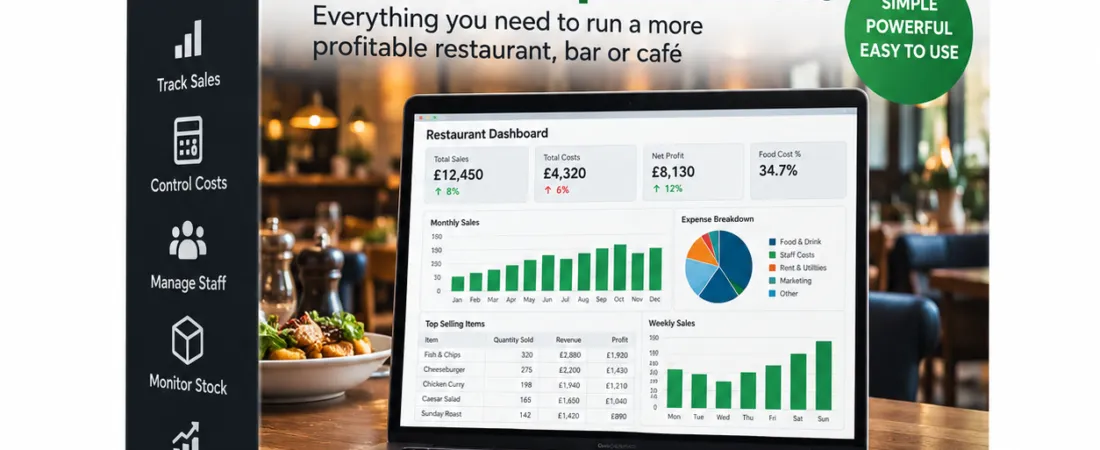
The Hospitality Command Centre is an Excel and Google Sheets spreadsheet for UK restaurants, pubs and cafés. It keeps your menu costings, takings and stock in one place, so you can see your GP without building the formulas yourself.
- Menu & Recipe Costing: enter the cost and sell price for each dish and drink to see the gross profit in pounds, the GP % and a Healthy/Review flag against your own target margin.
- Stock Control: par levels and current counts, with low items flagged “Reorder” and your stock value calculated.
- Daily Takings: food, drink and other sales, covers, average spend per cover and the cash/card split.
- Dashboard: cost of sales, gross profit and colour-coded checks on GP % and wage cost %. It’s £29.99 one-off, with no subscription.
See the Hospitality Command Centre →
Food GP FAQs
Is GP calculated before or after VAT?
After you take VAT off. If you’re VAT-registered, divide the menu price by 1.2 for standard-rated food before working out GP. Calculating GP on the VAT-inclusive price makes your margins look better than they are.
How do you calculate a 70% GP price?
Divide the plate cost by 0.3, then multiply by 1.2 to add VAT. A dish costing £3 to plate needs a menu price of at least £12 (£3 ÷ 0.3 = £10, plus VAT).
What is a good GP for a restaurant?
There’s no single right figure. It depends on your venue, menu and overheads. Work out how much gross profit you need each week to cover your wages, rent and other costs and still make a profit. Then set a target that gets you there and check every dish against it.
What’s the difference between GP and markup?
GP is the profit as a percentage of the selling price. Markup is the profit as a percentage of the cost. A dish that costs £3 and sells for £10 (before VAT) has a 70% GP but a 233% markup.
This guide is general information, not financial or tax advice. Prices and costs are examples only. VAT rules depend on what you sell and how, so check GOV.UK or ask your accountant about your own business.
Get this guide as a free PDF
Keep it, print it, read it offline. We’ll email it to you with a personal 10% discount code for any spreadsheet.