
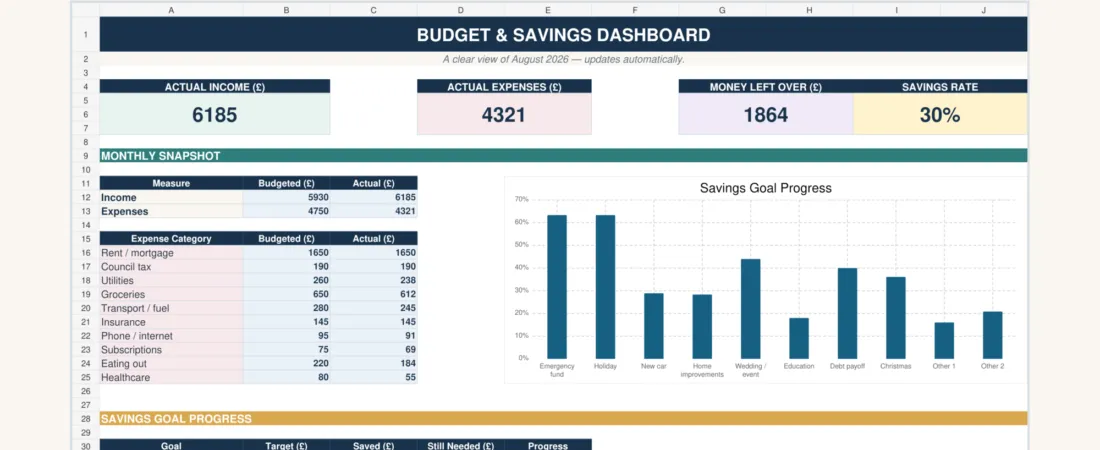
To make a monthly budget, add up the money you actually take home each month, list every outgoing (including the annual bills that catch you out), give every pound a job, then compare what you planned with what you really spent at the end of the month. The 50/30/20 rule is a useful starting point: 50% on needs, 30% on wants, 20% on savings and debt. In the UK, where rent, energy and council tax take a big bite, many people need to adjust those percentages, and that’s fine.
This step-by-step guide shows how to make a monthly budget in the UK, with a worked example and a version of the 50/30/20 rule that fits real UK bills. If you’d like a ready-made layout, the Budget & Savings Tracker has the categories and budget-vs-actual columns set up already.
Get this guide as a free PDF
Keep it, print it, read it offline. We’ll email it to you with a personal 10% discount code for any spreadsheet.
Step 1: Work out your monthly take-home pay
Use the money that actually lands in your account, after tax, National Insurance, pension contributions and student loan repayments. Your payslip shows this as net pay.
- Paid monthly: use your net monthly pay.
- Paid weekly: multiply weekly pay by 52, then divide by 12. Weekly pay of £520 is £520 × 52 ÷ 12 = £2,253.33 a month, not £2,080 (which would be 4 weeks).
- Irregular income (self-employed, overtime, tips): budget on your lowest typical month, and treat anything above it as a bonus for savings.
- Add other regular income, such as Child Benefit, Universal Credit or maintenance payments.
Step 2: List every outgoing
Go through the last two or three months of bank and card statements and write everything down. Group it into:
- Needs: rent or mortgage, council tax, energy, water, food shopping, phone, broadband, insurance, transport to work, childcare, minimum debt repayments.
- Wants: eating out, takeaways, streaming subscriptions, clothes beyond basics, hobbies, holidays, gifts.
- Savings and extra debt payments: emergency fund, savings goals, pension top-ups, overpaying debts.
Don’t forget annual and irregular bills
Most budgets fail because of costs that don’t arrive every month. Turn each one into a monthly figure by dividing the yearly cost by 12:
| Bill | Yearly cost | Monthly amount to set aside |
|---|---|---|
| Car insurance | £540 | £45 |
| MOT and service | £300 | £25 |
| TV licence | Check the current fee | Fee ÷ 12 |
| Christmas and birthdays | £600 | £50 |
Our guide to emergency funds and sinking funds shows how to save for these in separate pots.
Step 3: Apply the 50/30/20 rule (UK version)
The standard rule splits take-home pay like this:
- 50% needs
- 30% wants
- 20% savings and paying off debt (beyond the minimum)
For many UK households, especially renters in cities, needs come to more than 50%. If that’s you, don’t abandon the rule; adjust it:
- 60/20/20 if your housing costs are high: needs 60%, wants 20%, savings 20%.
- 70/20/10 if money is tight: protect at least a small savings habit while you cut costs elsewhere.
- Paying off expensive debt? Put most of the 20% there first, while building a small emergency buffer.
The percentages are a guide. The habit of deciding in advance is what matters.
Worked example: £2,400 a month take-home
Sam takes home £2,400 a month. The straight 50/30/20 split would be £1,200 needs, £720 wants and £480 savings. Sam’s needs actually come to:
| Need | Monthly |
|---|---|
| Rent | £850 |
| Council tax | £140 |
| Energy | £110 |
| Water | £40 |
| Food shopping | £220 |
| Phone and broadband | £45 |
| Travel to work | £80 |
| Car insurance and MOT (set aside monthly) | £70 |
| Total needs | £1,555 |
That’s 65% of take-home pay, so Sam uses a 65/20/15 split instead:
- Needs: £1,555 (65%)
- Wants: £480 (20%), covering eating out, subscriptions, clothes and the Christmas pot
- Savings: £365 (15%, rounded), going to the emergency fund first
£1,555 + £480 + £365 = £2,400. Every pound has a job.
Step 4: Track actual spending against your plan
A budget is a plan. You only find out if it works by checking what really happened. Once a week, or at least at the end of each month:
- Record what you actually spent in each category.
- Compare it with what you budgeted.
- Look at the biggest gaps. Overspent on food? Was it a one-off or does the budget need to be more realistic?
- Move money between categories if you need to, but keep the total the same.
Step 5: Review and adjust each month
Your first budget will be wrong, and that’s normal. After two or three months your figures will be based on real spending rather than guesses. Review when anything changes: a pay rise, a new bill, a price rise from your energy supplier or a change in rent.
Quick tips that make budgets stick
- Pay yourself first: move your savings amount on payday, not at the end of the month.
- Budget from payday to payday, not from the 1st of the month, if your pay date doesn’t match.
- Cancel or pause subscriptions you don’t use. Go through your bank statement line by line.
- Plan your meals. Food is the biggest flexible cost for most households.
- Leave a small “miscellaneous” line for the costs nobody plans for.
An easy way to keep on top of it
The Budget & Savings Tracker is a simple spreadsheet for planning each month and checking it against real figures. It’s a macro-free Excel file that can also be used in Google Sheets.
- Monthly income and expense sections with budgeted vs actual comparisons, so you can see exactly where you went over.
- 20 editable expense categories and 8 editable income sources, so you can set it up around your own bills.
- Automatic dashboard showing income, expenses, money left over, your savings rate and goal progress.
- 10 savings goals, each with a target, date and progress tracking.
See the Budget & Savings Tracker →
Monthly budget FAQs
Does the 50/30/20 rule work in the UK?
As a starting point, yes. But with UK rents and bills, many households spend more than 50% on needs. Adjusting to 60/20/20 or similar is common and still works, as long as you save something every month.
What should I include in a monthly budget?
Your take-home income from all sources, every regular bill, food and travel, monthly amounts for annual bills (car insurance, MOT, TV licence, Christmas), spending money, savings and debt repayments.
How much should I spend on food a month in the UK?
It depends on household size, diet and where you shop. The best figure is your own: total your supermarket spending from the last two or three months’ statements and divide by the number of months.
What’s the easiest way to start budgeting?
Start by tracking what you spend for one month without changing anything. Then use those real figures to set your first budget.
This guide is general information, not financial advice. If you’re struggling with bills or debt, free, impartial help is available from MoneyHelper and debt advice charities.
Get this guide as a free PDF
Keep it, print it, read it offline. We’ll email it to you with a personal 10% discount code for any spreadsheet.