Allowable expenses are the day-to-day running costs of your business that you can take off your income before working out your taxable profit. If you’re self-employed in the UK, that includes things like stock, tools, business travel, phone and internet use, insurance, advertising and part of your home running costs. You can only claim the business part of anything you also use personally, and you can’t claim expenses at all if you use the £1,000 trading allowance instead.
This guide lists the allowable expenses for self-employed people in the UK by category, with what you can’t claim, worked examples, and a simple way to record them. If you want somewhere to log them as you go, the Income & Expense Tracker is built for exactly that.
Get this guide as a free PDF
Keep it, print it, read it offline. We’ll email it to you with a personal 10% discount code for any spreadsheet.
Allowable expenses by category
These are the categories GOV.UK lists for sole traders and partners, with typical examples.
| Category | Examples you can usually claim |
|---|---|
| Office costs | Stationery, printer ink, postage, phone and internet bills (business share) |
| Travel | Fuel, parking, train, bus and taxi fares, hotel rooms, meals on overnight business trips |
| Vehicle running costs | Insurance, repairs and servicing, vehicle tax, breakdown cover, hire charges (business share), or a flat mileage rate instead |
| Clothing | Uniforms, protective gear like safety boots and hard hats, overalls used only for work |
| Staff costs | Wages, subcontractor costs |
| Things you buy to sell on | Stock, raw materials, direct costs of producing goods |
| Financial costs | Business insurance, bank charges |
| Business premises | Rent, heating, lighting, business rates |
| Advertising and marketing | Website costs, directory listings, leaflets |
| Subscriptions | Trade or professional journals and bodies |
| Training | Courses that update skills you already use in your business |
What you can’t claim
Most mistakes come from claiming things that feel like business costs but aren’t allowable:
- Everyday clothing, even if you only wear it for work. A suit, plain black trousers or ordinary shoes don’t count.
- Commuting: travel between home and a permanent place of work.
- Fines and penalties, including parking tickets and speeding fines.
- Entertaining clients, suppliers or customers, such as a business lunch or event tickets. Staff events where employees are the main attendees are treated differently.
- Food, drink or tobacco given away as gifts. Branded promotional items like pens or diaries can be claimed up to £50 per recipient per tax year.
- Money you take out for yourself. Drawings aren’t an expense.
- The personal share of mixed-use costs.
Buying equipment, machinery or a vehicle that you keep and use in the business is handled differently. Depending on whether you use the cash basis or traditional accounting, it is either an allowable expense or claimed through capital allowances. Cars are always claimed through capital allowances (unless you use the flat mileage rate).
Splitting costs you use personally too
If something has both business and personal use, you can only claim the business part. You need a reasonable, consistent way to split it.
Phone example (from GOV.UK): your phone bill is £200 and £70 of it is business calls. You can claim £70.
Working from home, by actual costs: your home has 4 rooms and one is used only as an office. Your electricity bill is £1,120 a year, so you could claim £1,120 ÷ 4 = £280. If you only worked from home one day a week, that would be £280 ÷ 7 = £40.
Working from home, flat rate: instead of splitting bills, you can use simplified expenses if you work 25 hours or more a month from home:
| Hours worked at home per month | Flat rate per month |
|---|---|
| 25 to 50 | £10 |
| 51 to 100 | £18 |
| 101 or more | £26 |
So working 60 hours a month from home all year gives £18 × 12 = £216. The flat rate doesn’t cover phone and internet; you can still claim the business share of those separately.
For a car or van, you choose between a flat mileage rate and actual running costs. Our guide to simplified expenses vs actual vehicle costs walks through both, and how to claim business mileage covers the 2026/27 mileage rates.
Trading allowance or expenses: which is better?
If your self-employed income is small, you can choose the £1,000 tax-free trading allowance instead of claiming expenses. You can’t do both.
- Side hustle A: income £3,000, expenses £600. The trading allowance gives a £1,000 deduction, so taxable profit is £2,000 rather than £2,400. Use the allowance.
- Side hustle B: income £3,000, expenses £1,400. Claiming expenses gives a taxable profit of £1,600 rather than £2,000. Claim expenses.
The rule: if your real allowable expenses are more than £1,000, claim them. If not, the allowance is usually better, and it saves you keeping detailed expense records for tax.
Worked example: a year’s allowable expenses
A self-employed dog walker earns £24,000 in the 2026/27 tax year and claims:
| Expense | Amount claimed |
|---|---|
| Public liability insurance | £180 |
| Leads, treats bags and equipment | £240 |
| Phone (business share of £480) | £240 |
| Website and booking app | £156 |
| Waterproof work coat and boots | £150 |
| Van mileage: 6,000 business miles at 55p | £3,300 |
| Working from home flat rate (£10 × 12) | £120 |
| Total allowable expenses | £4,386 |
Taxable profit is £24,000 − £4,386 = £19,614. To see roughly what tax that means, read how much tax to set aside when self-employed.
Note the coat and boots: they count because they are protective work gear used only for work, not everyday clothing.
Records you need to keep
HMRC expects you to keep records of all business income and expenses, with proof such as receipts, bank statements and sales invoices. Keep them for at least 5 years after the 31 January submission deadline of the tax year they relate to. For records from the 2026/27 tax year, whose return is due by 31 January 2028, that means keeping them until at least 31 January 2033.
The simplest habit: log each expense the day you pay it, with the date, supplier, amount, category and where the receipt is.
See also: Self-Employed Hairdresser Expenses: What You Can Claim (UK) and Photography Business Expenses: What You Can Claim (UK).
An easy way to keep on top of it
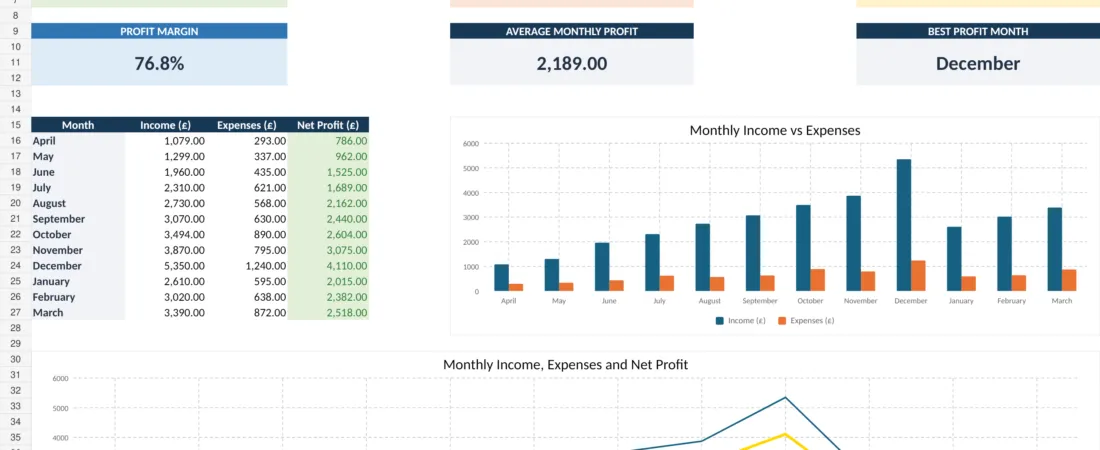
The Income & Expense Tracker is a simple spreadsheet for sole traders and side hustles who want to see what’s coming in and going out without learning accounting software. It works in Excel, Google Sheets or Numbers.
- Simple monthly log for every income and expense transaction.
- Categorises income and expenses, so you can see where your money goes each month.
- Summary tab that totals income, expenses and your net position automatically.
- No formulas to write and no formatting to fix.
See the Income & Expense Tracker →
Allowable expenses FAQs
Can I claim my mobile phone as a business expense?
Yes, but only the business share. If roughly half your calls and data are for work, claim half the bill. Keep a note of how you worked out the split.
Can I claim food and lunch as self-employed?
Not your everyday lunch. You can claim meals on overnight business trips. Food or drink for clients is normally entertaining and isn’t allowable.
Can I claim expenses without receipts?
You need records to back up what you claim. A bank statement shows you paid, but a receipt or invoice shows what you bought. If a receipt is lost, keep the statement and a note of what it was for.
Can I claim gym membership if I’m self-employed?
Generally no. A gym membership is a personal cost, even if staying fit helps your work.
This guide is general information based on GOV.UK guidance as of October 2026, not tax advice. Rules differ for limited companies and some situations are more complex, so check GOV.UK or speak to an accountant if you’re unsure.
Get this guide as a free PDF
Keep it, print it, read it offline. We’ll email it to you with a personal 10% discount code for any spreadsheet.