
A UK invoice for trade work needs a unique invoice number, your name and address, the customer’s name and address, a clear description of the job, the date you did the work, the invoice date, the amounts charged and the total owed. If you are VAT registered it also needs your VAT number and the VAT worked out properly. Add clear payment terms and you will get paid faster and have fewer arguments about what was agreed.
This guide covers exactly what to include on an invoice in the UK as a tradesperson, with a filled-in example, the extra rules for VAT, and what you can do when a customer pays late. If you already use the Trade Business Command Centre, its Invoice tab fills most of this in for you from a Job ID.
Get this guide as a free PDF
Keep it, print it, read it offline. We’ll email it to you with a personal 10% discount code for any spreadsheet.
What GOV.UK says every invoice must include
GOV.UK lists the following for every invoice, whatever your trade:
- A unique invoice number. Use a simple sequence (1001, 1002, 1003) and never reuse a number, even if you cancel an invoice.
- Your business name, address and contact details.
- The customer’s name (or company name) and address.
- A clear description of what you are charging for.
- The supply date: the date the work was done or the goods were supplied.
- The invoice date.
- The amount(s) being charged.
- The VAT amount, if applicable.
- The total amount owed.
Extra details for sole traders
If you are a sole trader, the invoice must also show your own name as well as any business name you trade under. So “Dave Smith trading as Smith Plumbing” rather than just “Smith Plumbing”. If you use a business name, you must also give an address where legal documents can be delivered to you.
Extra details for limited companies
A limited company must use its full name exactly as it appears on the certificate of incorporation. If you choose to list directors on your invoices, you must list all of them.
What a good trade invoice adds
The legal list is the minimum. These extras save you chasing and phone calls:
- The job address, if it is different from the billing address. Landlords and letting agents often pay for work at several properties.
- Labour and materials on separate lines. Customers question a single lump sum far more often than an itemised one. If you work under the Construction Industry Scheme (CIS), the contractor only makes the CIS deduction from the labour part, so showing materials separately matters.
- Your quote or job reference, so the invoice ties back to what the customer agreed to.
- Any deposit already paid, shown as a deduction, with the balance left to pay.
- Payment terms and a due date (see below).
- How to pay: bank name, sort code, account number and the reference you want used.
Worked example: a bathroom job invoice
Here is how the figures look for a small job done by a VAT-registered plumber. The labour comes from a £240 day rate, the same figure used in our guide on how to price a job as a tradesperson.
| Line | Amount |
|---|---|
| Labour: 4 days at £240 | £960.00 |
| Materials: basin, taps, pipework and fittings | £620.00 |
| Subtotal (excluding VAT) | £1,580.00 |
| VAT at 20% | £316.00 |
| Total | £1,896.00 |
| Less deposit paid | £400.00 |
| Balance due by 14 November 2026 | £1,496.00 |
If you are not VAT registered, leave the VAT line off completely and do not show a VAT number. Never charge VAT if you are not registered.
VAT invoices: the extra rules
You must register for VAT if your taxable turnover for the last 12 months goes over £90,000. The test is a rolling 12 months, not the tax year, so check it every month. Once registered, you must issue VAT invoices to VAT-registered customers. HMRC’s VAT record-keeping notice says a full VAT invoice must show:
- a sequential invoice number;
- the time of supply (tax point) and the date of issue, if different;
- your name, address and VAT registration number;
- the customer’s name and address;
- a description of the goods or services, and the quantity or extent of each;
- the unit price;
- the rate of VAT and the amount excluding VAT for each line;
- the total excluding VAT;
- any cash discount offered;
- the total VAT, in sterling.
For supplies of £250 or less including VAT, you can issue a simplified VAT invoice with fewer details.
Construction work for other VAT-registered businesses: if you supply building and construction services to a VAT-registered contractor reported under CIS, the VAT domestic reverse charge usually applies. You do not charge the VAT yourself; the customer accounts for it, and your invoice must make clear the reverse charge applies. Read HMRC’s domestic reverse charge guidance before invoicing this type of work.
Payment terms and late payment
You can set your own payment terms, such as payment on completion, 7 days or 14 days. Put them on the quote and on the invoice. If you agree no payment date, GOV.UK says the customer must pay within 30 days of getting the invoice or the work, whichever is later.
Write the actual due date (“Payment due by 14 November 2026”), not just “14 days”.
Charging late payment interest to business customers
When the customer is a business, late payment law lets you claim statutory interest of 8% plus the Bank of England base rate, unless your contract sets a different rate. You can also claim a fixed sum for recovery costs, once per invoice:
| Amount owed | Fixed sum you can claim |
|---|---|
| Up to £999.99 | £40 |
| £1,000 to £9,999.99 | £70 |
| £10,000 or more | £100 |
Example: a letting agent pays the £1,896 invoice above 30 days late. Purely as an illustration, if the base rate were 4%, the statutory rate would be 12% a year. Interest would be £1,896 × 12% ÷ 365 × 30 = £18.70, plus the £70 fixed sum. Check the current base rate on the Bank of England website before you work it out.
These statutory rights apply to business-to-business work. For homeowners, only charge interest or late fees if they were clearly agreed in your terms before the job started.
Invoice checklist before you hit send
- Is the invoice number next in sequence and unused?
- Does it show your name (and trading name) and address?
- Is the customer’s name and address correct, plus the job address if different?
- Are labour, materials and any extras on separate lines?
- Are the supply date and invoice date both shown?
- If VAT registered: is your VAT number on it, with VAT worked out at the right rate (or the reverse charge noted)?
- Is any deposit deducted?
- Is there a due date and your bank details?
- Have you saved a copy? HMRC expects you to keep sales invoices for at least 5 years after the 31 January submission deadline of the tax year they belong to.
An easy way to keep on top of it
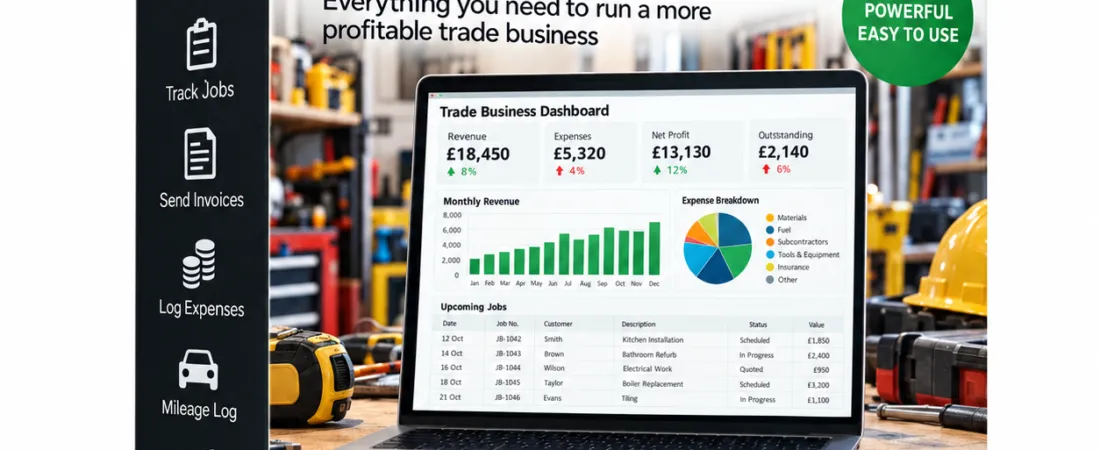
The Trade Business Command Centre is a spreadsheet for UK tradespeople that turns each job into an invoice and keeps track of who still owes you. It works in Excel, Google Sheets and LibreOffice, with no macros or subscription.
- Letterhead invoice that fills itself in from a single Job ID or customer, ready to save as a PDF. Enter a VAT rate (%) and it works out the VAT for you.
- Invoice Register that keeps every invoice you send. Type an invoice number back in and the invoice reloads.
- Jobs tab with automatic balance due and payment status for every job.
- Dashboard showing revenue, expenses, profit and outstanding balances at a glance.
See the Trade Business Command Centre →
Trade invoice FAQs
Can I write an invoice if I’m not a registered business?
Yes. A sole trader does not need to register a company to invoice. Include your own name, any trading name, and an address where legal documents can be delivered. You do need to register with HMRC for Self Assessment if you are self-employed and earn over the trading allowance.
Do I have to put VAT on my invoice?
Only if you are VAT registered. If you are not, leave VAT off completely. If you are, show your VAT number and the VAT at the correct rate, unless the domestic reverse charge applies.
What is the difference between an invoice and a receipt?
An invoice asks for payment. A receipt confirms payment has been made. Many tradespeople send the invoice and then mark it as paid, rather than issuing a separate receipt.
How long do I give a customer to pay?
Whatever you agree. Seven or 14 days is common for domestic work. If nothing was agreed, the default is 30 days. For business customers, an agreed period must usually be no more than 60 days.
This guide is general information based on GOV.UK and HMRC guidance as of October 2026, not tax or legal advice. VAT and CIS rules can be complicated, so check HMRC’s guidance or speak to an accountant if you’re unsure.
Get this guide as a free PDF
Keep it, print it, read it offline. We’ll email it to you with a personal 10% discount code for any spreadsheet.