Restaurant prime cost is your cost of goods sold (food and beverage) plus your total labor cost. Divide it by total sales to get your prime cost percentage. It’s the biggest controllable cost in most restaurants, and a commonly used rule of thumb for full-service restaurants is to keep it at or below about 60–65% of sales. Below is the formula, exactly what to include, a worked month for a full-service restaurant, and where to look when the number is too high.
The prime cost formula
- Prime cost = total cost of goods sold (COGS) + total labor cost
- Prime cost % = prime cost ÷ total sales × 100
- COGS = beginning inventory + purchases − ending inventory
- Labor cost % = total labor cost ÷ total sales × 100
Use the same period for every number, such as one week, one pay period or one month. Use sales before sales tax, since that tax is collected for the state rather than earned by you. If you track sales, purchases and shifts in one place, such as our Restaurant Spreadsheet US Edition, pulling these numbers together takes minutes instead of an afternoon.
Get this guide as a free PDF
Keep it, print it, read it offline. We’ll email it to you with a personal 10% discount code for any spreadsheet.
What counts as cost of goods sold
COGS is what you actually used up during the period, not what you bought. That’s why you need an inventory count at the start and end of every period. Include:
- Food
- Beer, wine, liquor and other beverages
- Paper goods and packaging, if you sell a lot of takeout. Be consistent: either include them every period or leave them out every period.
If your counts are off, your COGS is off. Our guide to how to do restaurant inventory walks through counting and valuing stock.
What counts as labor cost
This is where most owners understate prime cost. Labor isn’t just the hourly payroll. It includes:
- Hourly wages, including overtime
- Salaries for managers and chefs
- Employer payroll taxes. Your share of Social Security and Medicare is 6.2% plus 1.45% (7.65%) of wages, plus federal and state unemployment taxes.
- Workers’ compensation insurance
- Benefits you pay for, such as health insurance
Tips: tips your guests leave belong to your employees and aren’t your labor cost. The cash wage you pay tipped staff is, though. Under federal law, you can pay a cash wage as low as $2.13 an hour and take a tip credit of up to $5.12 toward the $7.25 federal minimum wage, but many states set higher minimums or don’t allow a tip credit, so check your state’s rules. You also pay the employer’s share of Social Security and Medicare on tips your employees report, so include that in your payroll taxes.
Worked example: one month at a full-service restaurant
A 70-seat restaurant has $90,000 in sales for the month: $68,000 food and $22,000 beverage.
Cost of goods sold
| Food | Beverage | |
|---|---|---|
| Beginning inventory | $9,400 | $6,200 |
| + Purchases | $21,800 | $5,900 |
| − Ending inventory | $9,900 | $6,600 |
| COGS | $21,300 | $5,500 |
| Cost % of its own sales | 31.3% | 25.0% |
Total COGS: $21,300 + $5,500 = $26,800 (29.8% of sales).
Labor
- Hourly wages, including overtime: $17,600
- Salaries (general manager and head chef): $9,500
- Employer Social Security and Medicare: 7.65% × $27,100 = $2,073
- Unemployment taxes and workers’ comp: $780
- Health insurance contribution: $1,200
- Total labor: $31,153 (34.6% of sales)
Prime cost
$26,800 + $31,153 = $57,953, and $57,953 ÷ $90,000 = 64.4%.
That’s at the top of the usual range, so there’s not much room left for rent, utilities, repairs and profit. Notice what happens if the owner only counted wages and salaries: $26,800 + $27,100 = $53,900, or 59.9%. Leaving out payroll taxes, workers’ comp and benefits makes prime cost look 4.5 points better than it really is.
How to bring prime cost down
On the food and beverage side
- Cost every menu item. Know what each plate costs at today’s supplier prices and what margin it earns at its current menu price. Reprice items that have drifted.
- Compare theoretical and actual food cost. If your recipe costs say 29% and your inventory-based COGS says 31%, the gap is waste, over-portioning, comps, staff meals or theft.
- Order to par. Over-ordering ties up cash and increases spoilage.
- Check invoices against deliveries, including weights, counts and prices.
On the labor side
- Schedule to your sales forecast, not to last month’s schedule. Look at covers by day and daypart and stagger start times.
- Watch overtime. Under the federal Fair Labor Standards Act, non-exempt employees must be paid 1.5 times their regular rate for hours over 40 in a workweek, and you can’t average hours across two weeks. A line cook on $18 an hour working 46 hours costs $720 + (6 × $27) = $882 that week. Moving those 6 hours to a part-timer at $18 saves $54 in wages.
- Check your state and city rules. Some states and cities have daily overtime, meal-break rules or predictive scheduling laws that add costs if you change shifts late.
- Track labor by week, so you can act before the month is gone.
How often to calculate prime cost
Monthly is the minimum. Weekly is better if you can count inventory every week, because a bad week shows up while you can still fix it. Whatever you choose, count inventory at the same time on the same day each period and match the labor dates to the sales dates.
An easy way to keep on top of it
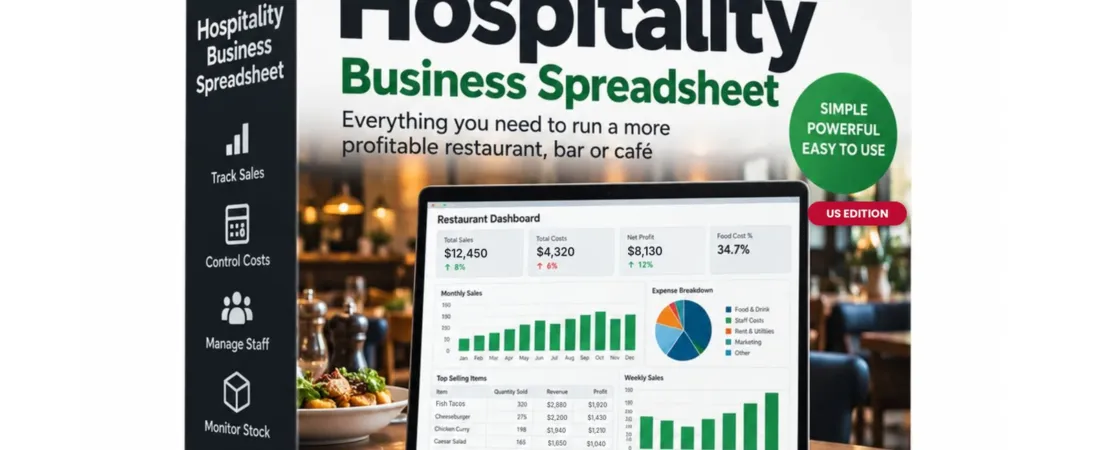
The Restaurant Spreadsheet US Edition is an Excel and Google Sheets workbook built for American restaurants, with US dollars, mm/dd/yyyy dates and sales tax. It puts both halves of prime cost on one dashboard.
- Dashboard: headline cards for revenue, cost of sales, gross profit, labor and net profit, plus a color-coded labor cost % health check and staff costs this month vs. last.
- Staff Schedule: 5,000 shift rows. Pick a name and role, and the rate, hours and shift cost fill in. Sick days and PTO can be flagged.
- Menu & Recipe Costing: cost and menu price for appetizers, entrées, desserts and drinks, with profit $, margin % and a Healthy/Review flag against your target.
- Daily Sales and Inventory: daily food, drink and other sales with covers and average spend per cover, plus par levels, on-hand counts and inventory value.
See the Restaurant Spreadsheet US Edition →
Restaurant prime cost FAQs
What is a good prime cost for a restaurant?
A common rule of thumb is 60–65% of sales or less for full-service restaurants, and lower for quick service. Your own target depends on your rent and other overheads, so track your own numbers over several months and set a target that leaves room for profit.
Is labor included in COGS for a restaurant?
No. COGS covers food, beverage and (if you choose) packaging. Labor is a separate cost. Prime cost is the figure that combines the two.
What is the 30-30-30 rule for restaurants?
It’s a rough guide that splits sales into about 30% COGS, 30% labor and 30% overhead, leaving about 10% profit. It’s a starting point, not a target that fits every concept.
How do you calculate labor cost percentage?
Divide total labor cost (wages, salaries, payroll taxes, workers’ comp and benefits) by total sales for the same period, then multiply by 100. In the example above, $31,153 ÷ $90,000 = 34.6%.
This guide is general information, not financial, tax or legal advice. Figures are examples only. Wage, overtime and payroll tax rules vary by state and city, so check with the U.S. Department of Labor, the IRS, your state labor agency or your accountant.
Get this guide as a free PDF
Keep it, print it, read it offline. We’ll email it to you with a personal 10% discount code for any spreadsheet.